

 Application Integration Hub
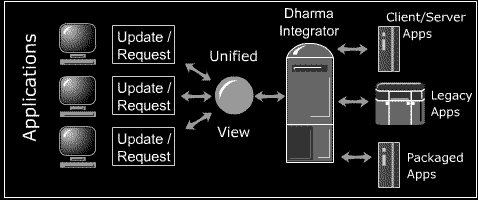
Dharma Integrator provides a common integration layer that enables e-business applications to access a unified view of business rules and information from multiple applications. This unified view enables new online value to be created from the existing IT infrastructure.
Unified View
Dharma Integrator provides a unified view of a corporation's existing business rules and information. Using industry standard techniques, legacy applications are easily leveraged by web development tools and application servers. New e-business applications are developed quickly and efficiently using well known tools and methods. With its open design and extensible architecture, Dharma Integrator also easily accommodates new requirements for application integration.
How It Works
As requests from e-business applications come in, Dharma Integrator identifies the application sources required to fill the request. This information may reside in custom or packaged applications.
Often a number of application sources can be used to satisfy a users request. When this is the case, Dharma Integrators optimizer will identify the most efficient method for meeting the needs of the e-business solution. This extensive optimization identifies the best ratio of network traffic, application load, and database server load.
Once the information is retrieved, it is rationalized. Any local processing for summing across disparate application sources or complex sorting is done at this time.
The information is then returned to the e-business application in a standardized format. The e-business developer does not require knowledge of the underlying applications.
